
Your Quartz Countertop Probably Isn't Stained
The posts show up in every kitchen group. A photo of a quartz counter, a dark ring or a red smear, and a caption somewhere between frustrated and frightened. My brand new countertop is stained. Six months old. What do I do.
Then forty people answer, and about thirty of them are wrong.
I have been fabricating stone for 40 years, 24 of them in my own shop. In all that time I have not seen a stain on quartz that a homeowner could not remove themselves. Not one.
Quartz Does Not Absorb Anything
Start with what quartz actually is. It is ground stone bound with resin, and it is nonporous. Liquid does not soak in. There is nowhere for it to go.
So when something looks like a stain on quartz, it is not down in the material. It is sitting on top of it.
The surface is not perfectly smooth either. Under magnification there is a fine texture to it, and dried red wine or tomato sauce or coffee can grip that texture. A wet sponge slides right over the top of it and does nothing.
That is the moment people panic. They wiped it, it did not come off, and they decided the counter is ruined.
It is not ruined. It just needs more than a sponge.
What to Actually Do, in Order
Work through these in sequence. Most things come off at step one or two.
- Rewet it and wait. Caesarstone's own care guide says dried spills should be reanimated with water for several minutes before you try anything else. Lay a wet paper towel over it and walk away. This alone solves a surprising number of countertop stains.
- Mild cleaner and some effort. Warm water, mild detergent, a soft cloth, and actual pressure. Clean a wider area than the spot itself so you do not leave a clean patch.
- A mild non-abrasive gel. Soft Scrub Liquid Gel is named directly in Caesarstone's care guide. Check your own brand first, which I will get to in a minute.
- Bar Keepers Friend powder, gently. Caesarstone approves it for metal marks and rust. A small amount on a damp cloth, very light pressure, circular motion, then rinse thoroughly. Do not use a scouring pad with it.
- Magic eraser, barely touching it. These work, and I have used them. Lean on one and you will dull the polish. If it is not lifting with light pressure, stop and call your fabricator.
Rinse and dry when you are done. Every time.
One thing that is not a stain. Caesarstone calls it patina. It is cleaner residue and film building up over time, and it can look like a pale, cloudy stain spread over an area rather than a defined spot. If your "stain" has no edges, you probably have buildup, and the fix is a proper clean and rinse rather than a stain remover.
Check Your Brand Before You Reach for a Cleaner
Here is the part nobody tells you, and it matters more than any product recommendation I could give.
The quartz brands do not agree with each other.
Caesarstone recommends Soft Scrub Liquid Gel by name and approves Bar Keepers Friend powder for metal marks. Cambria prohibits Soft Scrub, prohibits bleach, prohibits abrasives, and says exposure to those chemicals is not covered under its warranty. Cambria also says never to apply any sealer to their surface under any circumstances.
Same material category. Opposite instructions.
So before you scrub anything, find out what you own and read that manufacturer's care sheet. It takes two minutes. A lifetime warranty is worth two minutes.
If you do not know what brand is in your kitchen, ask whoever fabricated it. We keep that on file for every job we have ever done.
About the Fine Print
Every major quartz brand says stain resistant. None of them say stain proof.
Read far enough into the care documents and you will find specific callouts. Saffron and certain strong spices come up. Permanent markers. Dyes.
That language is there because a lawyer put it there, and I understand why. But in 24 years of running this shop, the saffron scenario has never once walked through my door. What walks through my door is dried spaghetti sauce and a homeowner who thought a sponge should have handled it.
Natural Stone Is a Different Question
Granite, quartzite, and marble are porous. They can absorb, which means they genuinely can stain.
That is what sealing is for, and a properly sealed stone should go five to seven years without trouble. Not forever. Not never. Five to seven years.
Here is how you check. Put a few drops of water on the counter and leave it fifteen minutes. Wipe it up. If the stone underneath darkened, the seal has worn thin and it is time to reseal. If it wiped away clean and the color is unchanged, you are fine.
Do that once a year and staining stops being something you think about.
If Natural Stone Does Stain, Use a Poultice
A stain in porous stone is not a countertop you have to live with. In my experience, something like nine out of ten come out with a poultice.
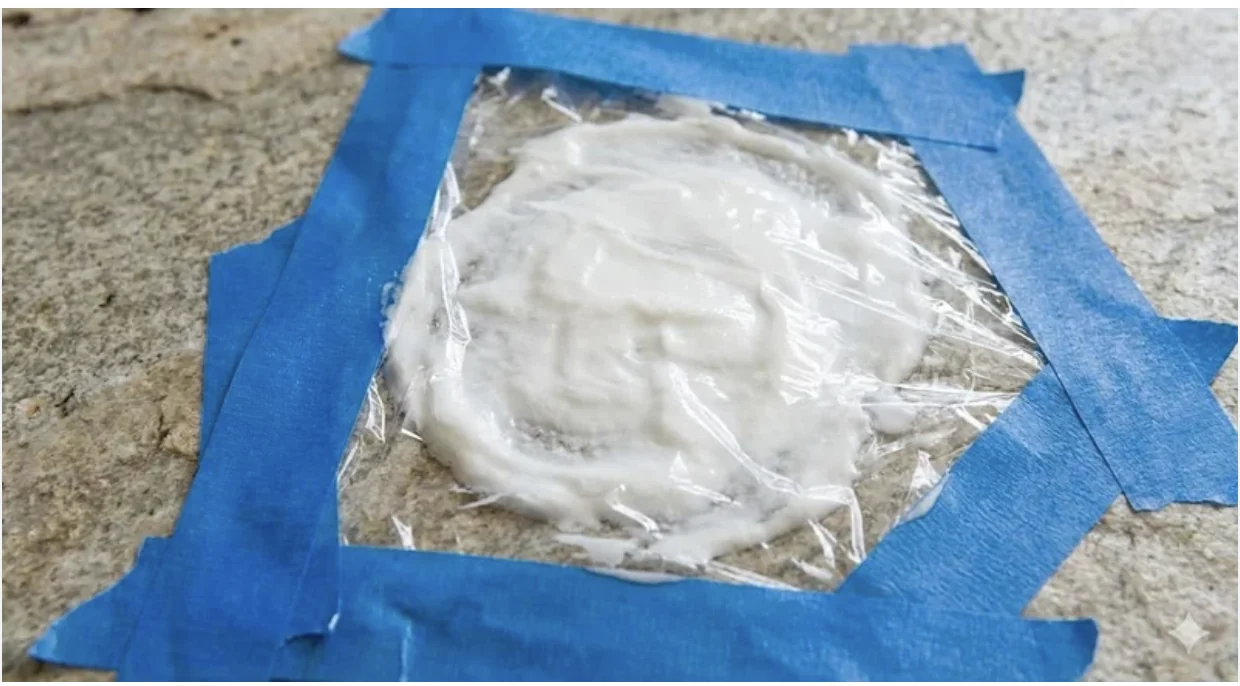
A poultice is an absorbent paste that pulls the stain back out of the stone the same way it went in. You can buy one made for stone at any home center or online, and that is the easiest route.
The version I have mixed myself for oil-based stains, and it has worked many times:
- Mix plaster of Paris with mineral spirits to a toothpaste consistency. Acetone works too.
- Spread it about a quarter inch thick over the stain, extending past the edges.
- Cover it with plastic wrap and tape down the edges.
- Leave it until the paste is completely dry. Usually 24 to 48 hours.
- Lift it off with a plastic scraper, wipe with a clean damp cloth, and let it air dry.
The solvent breaks down the oil. The paste draws it up as it dries. Sometimes it takes a second round.
Then reseal that area, and honestly reseal the whole top. If it absorbed a stain, the seal was gone.
Two cautions. Mineral spirits and acetone are flammable and the fumes are strong. Open a window and put the pets and kids somewhere else. And test any poultice on an out-of-the-way spot first, especially on light or polished stone.
One Thing This Post Is Not About
Marble.
Most people who say their marble is stained do not have a stain. They have etching, which is a chemical reaction where an acid has dulled the polish, and it needs a completely different fix. Scrubbing it will not help.
That one deserves its own post, and it will get one.
What This Comes Down To
Quartz does not really stain. It collects things on the surface that need a little more than a sponge.
Sealed natural stone does not really stain either, as long as you check it once a year and reseal when it stops beading.
And when either one does happen, it is almost always fixable at the kitchen counter with products from the hardware store.
A countertop stain is a bad afternoon. It is not a new countertop.
Not sure what you are looking at? Send us a photo. We will tell you whether it is a stain, a patina, or an etch, and what to do about it. You do not have to be a customer. Give us a call.