
Should the Seam Go Through the Middle of Your Sink?
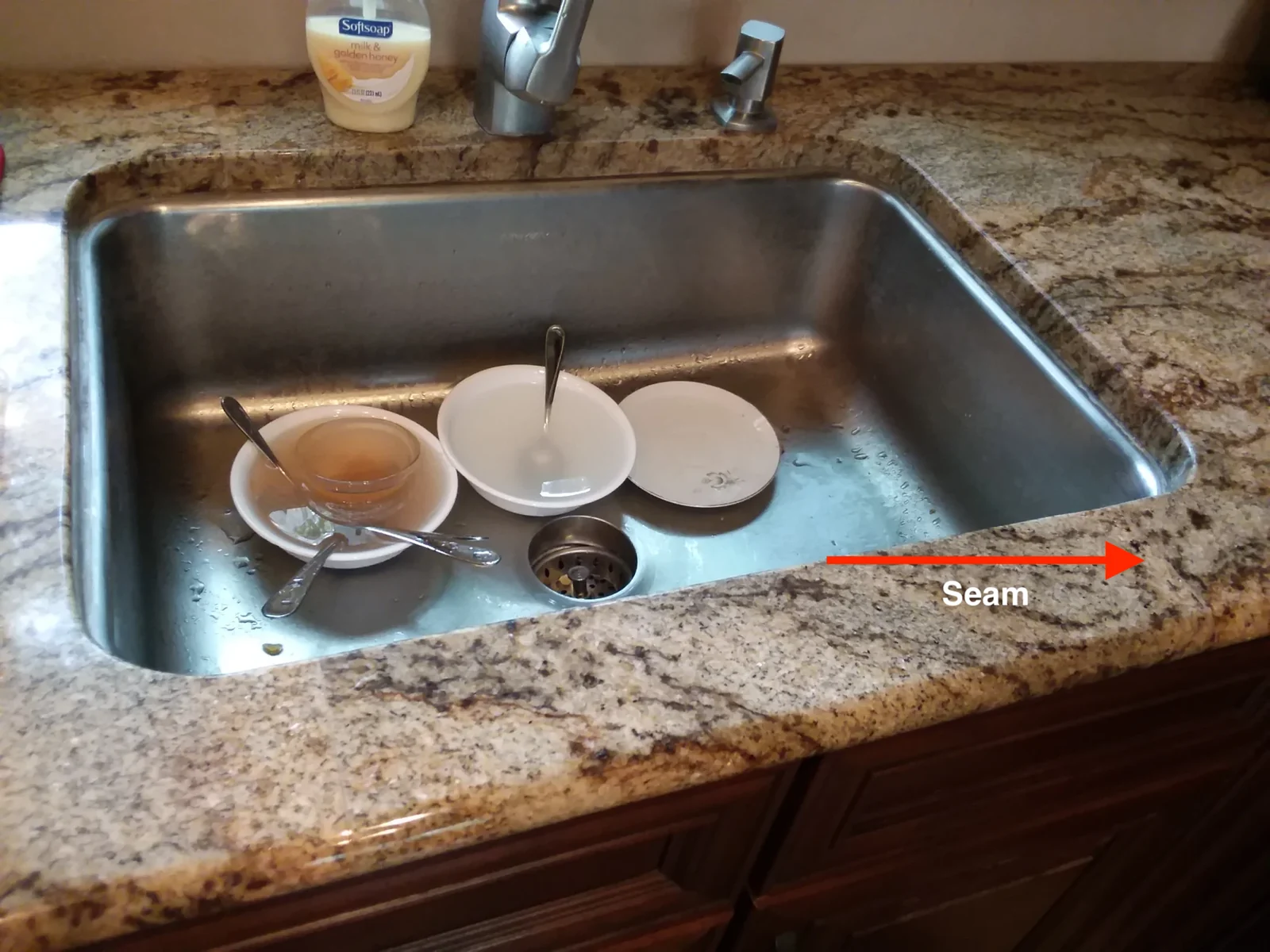
A woman posted on a design forum the week before she signed off on her template. She had done her homework. She knew a seam at the sink was normal. She knew it was acceptable. She just did not want it dead center, where she would notice it every time she stood at the window.
So she asked her fabricator to slide it a few inches to one side.
"They looked at me like I was crazy. But said they could do it."
I get that same look. From people in my own industry.
The Structural Question Is Settled
Let me take the scary part off the table first, because this is what people are really asking.
There is no structural reason to avoid a seam at the sink.
That area is fully supported by the cabinet below it. The two-part epoxy we use to join the two pieces is not affected by water. It does not soften, it does not let go, and it does not wick moisture into the stone.
A properly made seam at a sink will outlast the kitchen it sits in.
Where the Water Fear Actually Comes From
The worry is not irrational. It is just a generation out of date.
With laminate countertops, water in a seam is a real problem. The particleboard substrate underneath swells, the seam lifts, and the damage is permanent. Anyone who lived through a laminate kitchen learned to fear a seam near water, and they were right to.
Stone is not laminate. There is no substrate to swell.
Natural stone is porous, so it does take on a little moisture. That is why we seal it. What it does not do is swell, lift, or come apart at the joint. Neither the stone nor the epoxy is affected by water the way a laminate seam is.
The advice was correct once. It just got carried into a material where it does not apply.
Sometimes the Seam at the Sink Is the Safer Choice
Here is the part almost nobody explains to homeowners.
A sink cutout leaves a narrow bridge of stone at the front and back. On a long run, that narrow section is the weak point. It carries tension during transport, during the carry into your house, and during the lift onto the cabinets.
Long single pieces break at exactly that spot.
Putting a seam there releases the tension before it becomes a crack. You are not accepting a compromise. You are removing the riskiest moment in the whole job.
So when a fabricator tells you they want a seam at your sink, that is usually good judgment, not laziness.
Why Do I Offset It?
Because of the window.
Almost every kitchen sink sits under one. That makes the center line of the sink the single most looked-at spot on your countertop. Your eye goes there when you walk in the room. It goes there every time you stand at the faucet.
Now put daylight behind it.
Light raking across a horizontal surface finds every line on it. A seam that would disappear anywhere else on the counter gets picked out and lit from the side, dead center in your field of view.
The seam is fine. The location is just the worst possible place to put a line you would rather not see.
My Recommendation
If the layout needs a seam at the sink, and it often does, I offset it.
I bring it in close to the edge of the sink cutout. Roughly three inches from the left or right side. The seam is still at the sink, so it still does its structural job and still releases the tension.
But when you stand at the faucet and look down that center line, there is nothing there.
Same seam. Same strength. Out of the sight line.
Not Everyone in My Trade Agrees
I want to be straight with you about that.
Plenty of good fabricators put the seam dead center on purpose. Their reasoning is symmetry. The faucet and the sink center line already draw a vertical axis, so a seam on that axis reads as intentional rather than accidental. Centered on the layout, centered on the sink, centered under the faucet.
It is a real argument and I understand it.
I have just watched too many people stand at their new counter and find that line every single morning. Symmetry is a drawing-board idea. The window is a real one.
What to Ask Before You Sign the Template
Ask where the seams are going and why.
Ask to see it marked on the drawing before anything is cut. Once fabrication begins, there are no adjustments.
And if you would rather the seam not land dead center at your sink, say so. It is not a difficult request. It costs nothing. Any shop that handles the sink cutout carefully can do it.
The woman on the forum got what she asked for. She just had to be willing to look a little crazy for a minute.
Planning a countertop and wondering where the seams will land? We mark seam placement on your layout before anything gets cut, and we will tell you why each one is where it is. Give us a call.